

May 31, 2026
If you’ve been considering building a custom home, you’ve probably heard at least one story like this: someone’s friend or family member built a house, the bid came in at $800,000, and by the time they got their keys the final number was well over $1.2 million. Nobody could explain exactly where it went: dozens of small change orders that added up fast, allowances that ran short on nearly everything, and questions that got harder to ask as the build went on.
That’s not bad luck. That’s what happens when a bid is built around a number that looks good on paper and you aren’t sure which things to question. The good news is that a custom home bid will tell you a lot, if you know what you’re reading! Here’s how we at Jace & Bowen Custom Builders suggest you read a custom home bid.
Start With the Scope of Work, Not the Price
Most people flip straight to the final number. You want to know the bottom line and we don’t blame you. But that number is only meaningful if you understand what it includes.
The scope of work is the list of everything the builder is committing to do. If it’s not written here, it’s not included, no matter what was discussed in a phone call or meeting.
Things that get left out of bids regularly: site clearing, driveway, retaining walls, landscaping, fencing, and design selection levels. Watch for language like “finish carpentry as needed” or “site work per plan.” The phrase “as needed” hands the definition of “needed” to the builder. Be sure to get specific about what that means with your builder.
In the Lampasas and Hill Country areas specifically, site work deserves extra scrutiny. Rocky terrain, caliche soil, long utility runs across large lots, well and septic systems. These costs can vary enormously depending on your land.
It’s also why we use site walks as one of our first meetings. We want to get eyes on your land before we write a single number. Our bid may not always be the lowest at first glance, but the scope of work behind it will reflect what the project actually requires.
Labor and Materials: Priced Together?
Here’s something worth understanding before you read a bid: not every trade gets broken into separate labor and materials lines and that’s not automatically a problem.
Trades like HVAC, roofing, framing, and plumbing are typically bid by subcontractors as a complete package. The sub quotes the whole job as one number: labor, materials, everything included. That’s standard in the industry and a builder who presents those as a single line item isn’t hiding anything. That’s just how those trades are priced in the real world.
There’s also a practical reason to keep it that way: an overly itemized budget with dozens of sub-lines can create complications during the bank draw process and it makes the document harder to read and track. Consolidating those trades into clean, clear line items keeps the budget manageable for everyone.
Where separation matters more is in the finish trades, specifically the items you’ll be selecting. Plumbing fixtures and electrical fixtures are often broken out as their own allowance lines, separate from the labor to install them. That distinction is useful because it shows you exactly what’s available to spend on the things you’ll actually choose, versus what’s going to the crew installing them.
What you want to avoid is a bid where everything gets buried under a handful of large, vague categories with no breakdown at all. A bid that clearly identifies each trade as its own line, even if HVAC and framing are presented as combined numbers, gives you real visibility into where the money is going.
The question to ask isn’t “are labor and materials separated for every trade?” It’s “can I see what I’m spending on each part of the build, and do I understand what each number covers?”
Allowances: This Is Where Budgets Get Away From People
Allowances are placeholder dollar amounts for things you haven’t selected yet: flooring, tile, light fixtures, plumbing fixtures, appliances, cabinets, countertops. They’re a normal part of every bid.
When allowances are set too low, the overall bid number looks more competitive, so you sign. Then selections start and nearly every allowance will run short. By the time you realize it, you’re deep into a build you’re committed to and every overage becomes a change order. Those $3,000 and $5,000 adjustments will add up fast. Homeowners describe going $60,000 to $90,000 over budget this way.
The “tier gap” on selections can be significant. There’s a meaningful price difference between an entry-level window package and Anderson or Marvin windows. Between code-minimum batt insulation and spray foam. Between a standard appliance package and Jenn-Air.
What you want to see is a well-structured bid: a note next to each line item that tells you exactly which selection the price is based on, something like *price for Anderson windows or *price for spray foam insulation or *price for Jenn-Air appliances. That annotation tells you what was used to determine the allowance, so if you want something different whether higher or lower selection, that conversation happens before you sign.
If a bid doesn’t have those notes, ask: “What selection did you use to price out the windows? The flooring? The appliances?” And specifically: “Can you show me an example of a product this allowance would buy?”
What a Good Bid Starts With
So how does the builder arrive at each allowance number? Do they just pick their favorite brands?
A well-built proposal starts with questions, detailed ones, before a single number gets written down. Things like:
- What percentage of the exterior is stone, stucco, or siding?
- What “tier” of windows are you planning?
- Shingles, tile, or metal roof?
- Spray foam insulation or batt and bib?
- Laminate countertops, granite, or quartz?
- Whirlpool appliances, KitchenAid, or Jenn-Air?
- Solid core or hollow core interior doors?
- Driveway in rock, asphalt, or concrete?
- Outdoor kitchen? Pool, or pre-plumb for one? Irrigation? Gutters?
That’s not the complete list; a thorough pre-bid questionnaire might cover 30+ questions that all affect the final price. But the point is this: if we don’t ask those questions before writing your bid we are working from assumptions. When a builder asks first about your vision and selection tiers, the allowances in your proposal reflect what you’re planning. The bid becomes a document with solid numbers, not a best-case scenario.
Here are Some Line Items that Trigger a Follow-Up Questions
Some words show up on bids regularly that sound reassuring but don’t actually tell you much. These are worth asking about specifically.
Custom cabinets: Does that mean built on-site by a local craftsman, or box-store stock with a custom door front? Both get called custom. The price gap between them is significant. Examples of questions you could ask: Ask for the cabinet manufacturer, the line, and whether they’re framed or frameless.
Premium windows: A Pella Reserve and a builder-grade vinyl window can both be called “premium” depending on who’s writing the bid. Example of questions you could ask: Ask for the brand, the specific product line, and the U-factor. (In a Texas summer, the difference between a low U-factor window and a high one will show up on your electric bill every single month.)
Standard insulation: Code-minimum batt insulation and spray foam could both be described as “standard” depending on the builder. One keeps your summer electric bill in check. The other doesn’t.
Turnkey: Sometimes turnkey stops at the front door. That means no landscaping, no driveway finish, no window treatments, no propane hookup. Before you accept “turnkey” as a complete answer, ask for the exclusions list. That document will tell you what you still need to budget for separately.
Design Services: Included, or On Your Own?
This one catches a lot of buyers off guard. You’ve answered the questionnaire, you have a preliminary budget, and now comes the part where you actually make all those selections. The question is: does your builder have a process for that, or are you figuring it out yourself?
Ask any builder you’re interviewing whether design services are included in the bid, and if so, what that actually looks like. The range is wide. Some builders hand you a link to a supplier’s website, others have an established relationship with a specific designer, and some have an in-house designer and physical place to go in order to make decisions.
The other question worth asking is whether you can see these products in person before final selection. There’s a real difference between choosing tile, flooring, or a cabinet finish on a computer screen and standing in front of the actual material. Colors will look differently in photos and in different light. Textures don’t translate the same in warehouse vs a smaller home setting. Selections made entirely off a screen are one of the most common sources of “that’s not what I pictured” regret after install. Then…you might get stuck with dealing with a change order process and lost time.
At Jace & Bowen Custom Builders we work directly with a designer and include six hours of complimentary design consultation with every build. That time is spent at a physical design center where you can see and touch the actual materials before you commit to anything. We’ve also brought samples directly to clients’ lots so they can see how a material look in the actual space and light conditions of their future home.
Some questions to ask as you read the bid: Does the builder have a design center? Is a designer included and for how many hours?
The Question Nobody Thinks to Ask: What Happens When It Comes in Under Budget?
Most people spend their energy worrying about going over budget. Fewer think to ask what happens if a line item comes in under.
It’s worth asking directly: if your builder gets trade bids and the actual cost is less than what was estimated, does that savings come back to you, or does it stay with the builder?
With the Jace & Bowen Custom Builder process, the answer is simple: you get to apply you overage to another line item. The preliminary budget is a starting point, not a ceiling. As the build progresses and actual trade bids come in for each line item, the numbers will get refined. If something comes in lower than the estimate, that savings go back to your build. And if something rings up higher, the conversation happens before work starts.
Ask any builder you’re considering to explain how this works in their process. A clear, specific answer is a good sign!
The Exclusions List: What’s Not in the Bid
Every custom home bid has exclusions and that’s normal. What matters for you as you read it is that they’re clearly listed.
Common exclusions to watch for:
- Permit and inspection fees
- Surveys
- SWPP (Stormwater Pollution Prevention Plan, a required permit in Texas, and not cheap)
- Site prep, clearing, and grading beyond a defined scope
- Well and septic installation (common on rural lots in Lampasas and Burnet Counties)
- Utility connection and meter fees
- Temporary utilities and site facilities during construction
- Driveway and flatwork
- Landscaping and irrigation
- Detached structures (garage, workshop, pergola)
- Fence
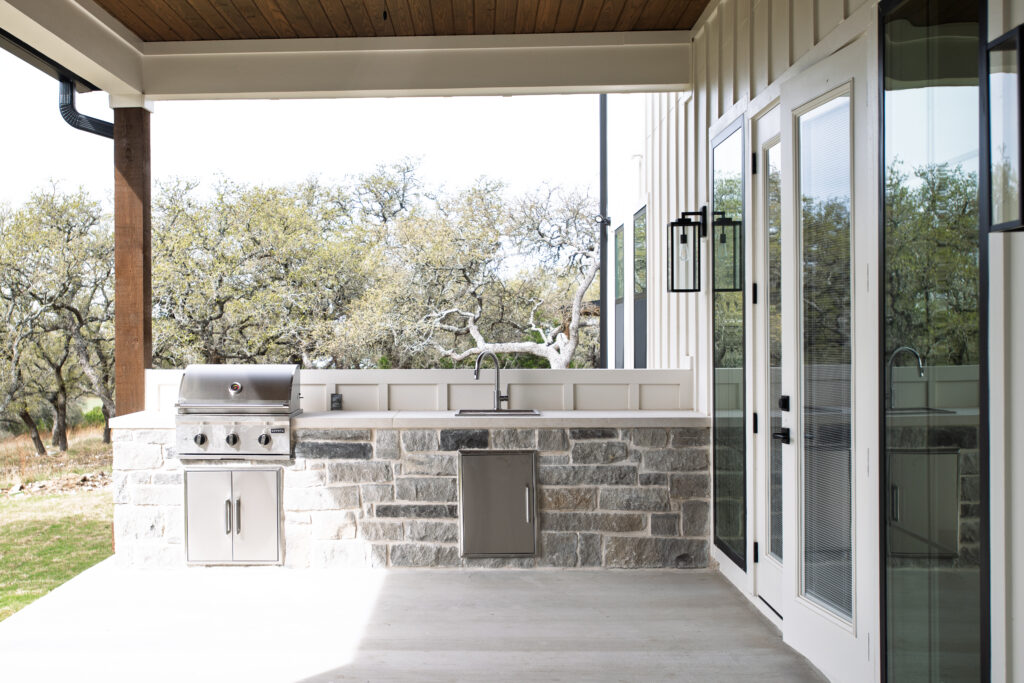
A few of these deserve some extra attention. Surveys are easy to overlook but required before you can build. SWPPP (Stormwater Pollution Prevention Plan) is a Texas requirement that many buyers have never heard of until their land requires they get one. Septic on a rural lot can easily run $35,000 to $50,000 depending on soil and system type. Site prep in the Hill Country, where rocky terrain is common, can vary significantly from lot to lot.
None of these being excluded is automatically a problem; it’s reasonable for some of these to be handled separately. But you need to know what they cost, budget for them, and know who’s responsible for coordinating each one.
If a bid doesn’t include an explicit exclusions section or if you and your builder haven’t have the exclusions discussion, ask the questions.
Fixed Price vs. Cost-Plus: Know Which One You Have
Most custom home bids will identify the type of contract you would be signing. What they don’t always do is explain what each variation means, so we thought we’d take a quick moment to do that here.
Fixed-price contract: The builder commits to a number. If they underestimated something, that’s on them. If lumber prices rise mid-build, they absorb it. Your price is your price, unless you make a change or submit a change order. The key word is unless. On a fixed-price contract, changes typically carry both a change fee and the cost of whatever is being changed. The price is stable as long as the scope is stable.
Cost-plus contract: You pay the actual cost of labor and materials, plus a builder fee, either a flat rate or a percentage. The fee is transparent and usually listed as its own line item. Because you see the actual costs as they come in, this structure can be very transparent. The important thing is staying in regular communication with your builder so you understand what’s being presented as costs come through.
Neither is wrong. Both have advantages depending on the project and the relationship. What matters is that you know which one you’re signing, what your exposure is, and how each handles costs that change.
Change Order Language
Change orders are how the final price moves after you’ve signed your contract.
What you want: written change orders required before any out-of-scope work begins, with your signature confirming approval. No signed change order, no work.
What you want to avoid: language that allows the builder to make field decisions and bill you after the fact. Once work is done, you have very little leverage.
Ask specifically: “Can you walk me through how change orders work? What triggers one, and at what point do I approve it?”
Changes happen on every build. That’s just the nature of custom home building. Being prepared for that and understanding the process ahead of time is what keeps them from being stressful or surprising.
Payment Schedule: Does It Match the Work?
A standard draw schedule is tied to milestones: foundation, framing, dry-in (roof and windows), rough mechanicals, drywall, trim and finishes, substantial completion, and final walkthrough. You pay as work gets completed. This will typically be how your lender handles draws as well.
Who’s Actually Building Your House?

Most custom home builders use subcontractors for some or all of the trades: framing, plumbing, electrical, HVAC, and so on. What you might be interested in knowing is how your builder sources their trades and if your builder is insured against any issues that could come up while the trades are on your build.
Ask: “Do you have established subcontractors you work with regularly, or do you re-bid each trade for each project?” “Do you have builder’s risk insurance?”
A builder with a consistent, trusted sub network typically has better quality control, better scheduling, and more accountability. When a builder and their trades have a working history, there’s a mutual reputation on the line, and that shows in the work and the timeline. Additionally, this might seem like a no-brainer, but meet with your project manager! Maybe go out to lunch or set up a zoom call. They are going to be your main source of information throughout the custom building process and it’ll be important that you feel comfortable with your POC.
What Happens After Move-In?
Warranty language can feel like fine print, but it matters more than most people expect.
Texas law requires a one-year warranty on workmanship, two years on mechanical systems, and ten years on structural defects. But the practical question isn’t what the law requires; it’s making sure you have the right phone numbers when something comes up six months after you move in.
Be sure you have the right numbers and contacts for anything that would have a warranty.
The Questions You Should Be Able to Answer Before You Sign
After reading and/or discussing a bid with your builder, you should be able to clearly answer all of these:
- What’s explicitly included, and what’s explicitly not?
- Are the allowances realistic for the finishes I actually want?
- What type of contract is this, and what does that mean for my budget exposure?
- What does the change order process look like, is it in writing?
- Does the payment schedule match construction milestones? Does it align with how my lender handles draws?
- How are subcontractors selected and managed? What types of insurance is carried during the building process?
- What does warranty coverage and post-build support look like?
If you don’t feel clear on these seven items, go ahead and ask your questions so you can build with confidence!
One Last Thing
The bid you receive might not be as thorough in explaining each detail as this long blog post and that doesn’t automatically mean you’ve received a “bad bid.” Our goal with these explanations is for you to be able to take the information you learn here to the bid you have and ask the questions that give you the most clarity and confidence.
At Jace & Bowen Custom Builders, the process works like this: before any numbers get written, you complete a detailed selections questionnaire and we complete a site walk so we can build a budget with better accuracy. The preliminary proposal comes back with full line-item pricing and tier notes on every allowance, so you know exactly what was priced and why. As design appointments happen and actual trade bids come in, the numbers will get dialed in. If a line item comes in under budget we discuss where to best allocate the overage. If something is running higher, that conversation happens early before it becomes a surprise.
Alec and Michael care deeply that their clients understand the custom home building process and get exactly what they were promised and envisioned.
If you’re comparing builders in Lampasas, Burnet, Liberty Hill, or the surrounding Hill Country area, we’d welcome that conversation and would love the opportunity to win your business. Reach out here to talk through your project, ask questions, and see how we put a proposal together.
Have a bid in hand that you’d like a second opinion on? We’re happy to look at it with you.


